
How Yom Teruah Became Rosh Hashanah
Sources: {My Jewish Learning, Jerusalem Talmud, Scripture}
How Did Yom Teruah Become Rosh Hashanah?
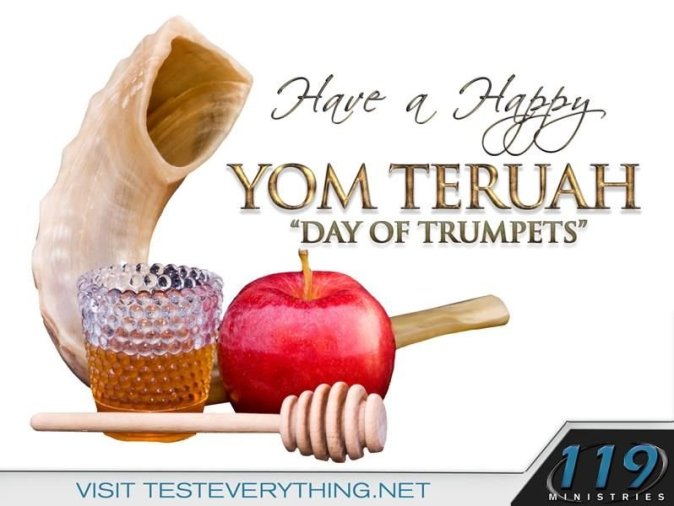
Today, let’s discuss how Yom Teruah (The Day of Trumpets) became Rosh Hashanah (The Civil New Year).
Leviticus 23:24-25:
“Speak to the sons of Israel, saying, ‘In the seventh month on the first of the month you shall have a rest, a reminder by blowing of trumpets, a holy convocation. You shall not do any laborious work, but you shall present an offering by fire to the Lord.’”
One of the unique things about Yom Teruah is that the Torah does not mention the purpose of this Holy Convocation. In fact, we have to wait until the sighting of the new moon to determine when the festival even begins. It is truly the day no one knows. In (Matthew 24:36), when Yahshuah said that no one knows the day or the hour, He was speaking concerning His second coming. Yet, it is remarkable how Yom Teruah, parallels Yahshuah’s statement. Could it be that Yom Teruah is a dress rehearsal to prepare our hearts for the day no one knows, the second coming of our beautiful King Messiah Yahshuah (1 Corinthians15:52 and Colossians 2:17).
Today, few people remember the biblical name of Yom Teruah (better known as the Day of Trumpets) and instead Yom Teruah is widely known as “Rosh Hashanah” which literally means “head of the year.”
Numbers 29:1:
‘Now in the seventh month, on the first day of the month, you shall also have a holy convocation; you shall do no laborious work. It will be to you a day for blowing trumpets.
1 Kings 8:2:
“And all the men of Israel assembled themselves unto king Solomon at the feast in the month Ethanim, which is the seventh month.”
During their sojourn in Babylonia the Hebrew people began to adopt the names of the Babylonian month, a fact readily admitted in the Talmud: “The names of the months came up with them from Babylonia.” (Jerusalem Talmud, Rosh Hashanah 1:2 56d)
According to 1st Kings 8:2, the Hebrew month (Ethanim) was the Hebrew name for the seventh month. Today, we refer to the seventh month as Tishrie, which is a Babylonian name in which our forefathers brought with them from Babylon. The word Tishrie is translated to “beginnings”.
Over time the original names of the Hebrew month fell into disuse. Only the month of Abib (Duet 16:1) and the month Ethanim (1 Kings 8:2), the 1st and 7th months are known to us according to scripture.”
The pagan nature of the Babylonian month names is epitomized by the fourth month known as Tammuz. In the Babylonian religion, Tammuz was the god of grain whose supposed annual death and resurrection brought fertility to the world. In the book of Ezekiel, the prophet described a journey to Jerusalem in which he saw the Jewish women sitting in the Temple “weeping over Tammuz.” (Ezekiel 8:14). What an atrocity!
As our Hebrew ancestors began to integrate into Babylonian society they became more susceptible to Babylonian influences.
From very early times the Babylonians had a lunar-solar calendar very similar to the Biblical Hebrew calendar. The Babylonians actually celebrated Akitu, New Years, twice every year, once on the first of Ethanim (Tishrie) and again, six months later on the first of Abib (Nissan), based on their agricultural cycle of sowing and reaping.
The result was that the Hebrew festival of Yom Teruah often fell around the same time as the Babylonian New Years fall festival of Akitu. All the people in the empire would celebrate this agricultural festival, including the Jewish citizens. Just like today, most citizens around the world celebrate January, 1st, as the civil New Year.
Is Rosh Hashanah A Biblical Feast Day?
Although the Torah does not mention Rosh Hashanah as being a civil or agricultural New Year. However, the common theme of Rosh Hashanah of self-reflection and reconciliation prepares our hearts to celebrate Yom Teruah!
Even the fiscal world has adopted Rosh Hashanah’s theme of reconciliation, wherein at the end of the fiscal year (Tishrei), all debts are reconciled and new appropriations are allotted. Rosh Hashanah has become associated with new beginnings – a time to start over again!
Sometime between the Torah and the codification of the Mishnah, the autumn New Year gained credence in the ancient world. Most ancient Semitic peoples considered the year to begin around the autumn harvest and the beginning of the rainy season, which both signified the start of a new agricultural year. Although the Torah never explicitly refers to an autumn new year, some scholars see in the Torah’s apparent timing of the fall harvest festival (Sukkot) a small hint of a possible fall new year.
Over time, Rosh Hashanah has been incorporated into Jewish life, as a time of new beginnings!”
At the beginning of the second century, the Mishnah outlines the teachings of the schools of Hillel and Shammai, concerning Rosh Hashanah, which date to the first century CE.
Although Rosh Hashanah, may have originated primarily as a new harvest year, according to the agricultural cycle, the Mishnah assigned Rosh Hashanah a theological purpose.
By attributing a different yet complementary role of Rosh Hashanah from Yom Teruah, teachers of Torah have helped integrate spiritual perspectives within the Jewish religion.”
The Sages taught that on Rosh Hashanah all human beings pass before God as troops, as it is said: The Lord looks down from heaven; He sees all mankind. From His dwelling place He gazes on all the inhabitants of the earth? He who fashions the hearts of them all, who discerns all their doings, (Psalms 33:13-15)” (M. Rosh Hashanah 1.2). God sees every stride that we make towards Him. Rosh Hashanah has its purpose in preparing our hearts through reflection and reconciliation so that we can celebrate Yom Teruah, and herald the coming of our Messiah with shouts of great joy and jubilation!
“Who shall ascend into the hill of the Lord? or who shall stand in his holy place? “He that hath clean hands, and a pure heart; who hath not lifted up his soul unto vanity, nor sworn deceitfully” (Ps. 24:3–4)
As we prepare our hearts to celebrate Yom Teruah, may we do so with joy! May this season be filled with redemption and reconciliation! May the coming of our Master Yahshuah be soon and in our lifetime! May we be watchful and prayerful, discerning the times in which we live!
Worship Experience:
_____________________ If you have not repented of your sins and made Jesus your Lord and Savior, please do so NOW! If you do not have a personal love relationship with Jesus, please invite Jesus into your heart NOW! CLICK HERE!









 TheGodBlog.Org